
Is there a greener way to insulate our draughty homes?
A guide to sustainable insulation
Whether you’re extending, renovating or self-building, choosing the right insulation is essential. Insulation boosts heat retention and cuts energy bills – but many mainstream products come with a sizeable carbon footprint. Some are derived from fossil fuels and can’t be recycled while others are manufactured using highly energy intensive processes. It’s always worth asking the question: will the long-term energy savings justify the environmental cost?
If you are looking for a genuinely greener home, it is well worth considering using alternatives, such as sheep’s wool, cellulose, wood fibre, hemp and cork. These bio-based materials typically require less energy to produce, are renewable and can either be composted or recycled.
There are health benefits, too. Natural insulating materials are less likely to leak toxic chemicals into your home, making it a healthier place to live. But can the best eco insulation compete with synthetic materials on thermal performance and cost?
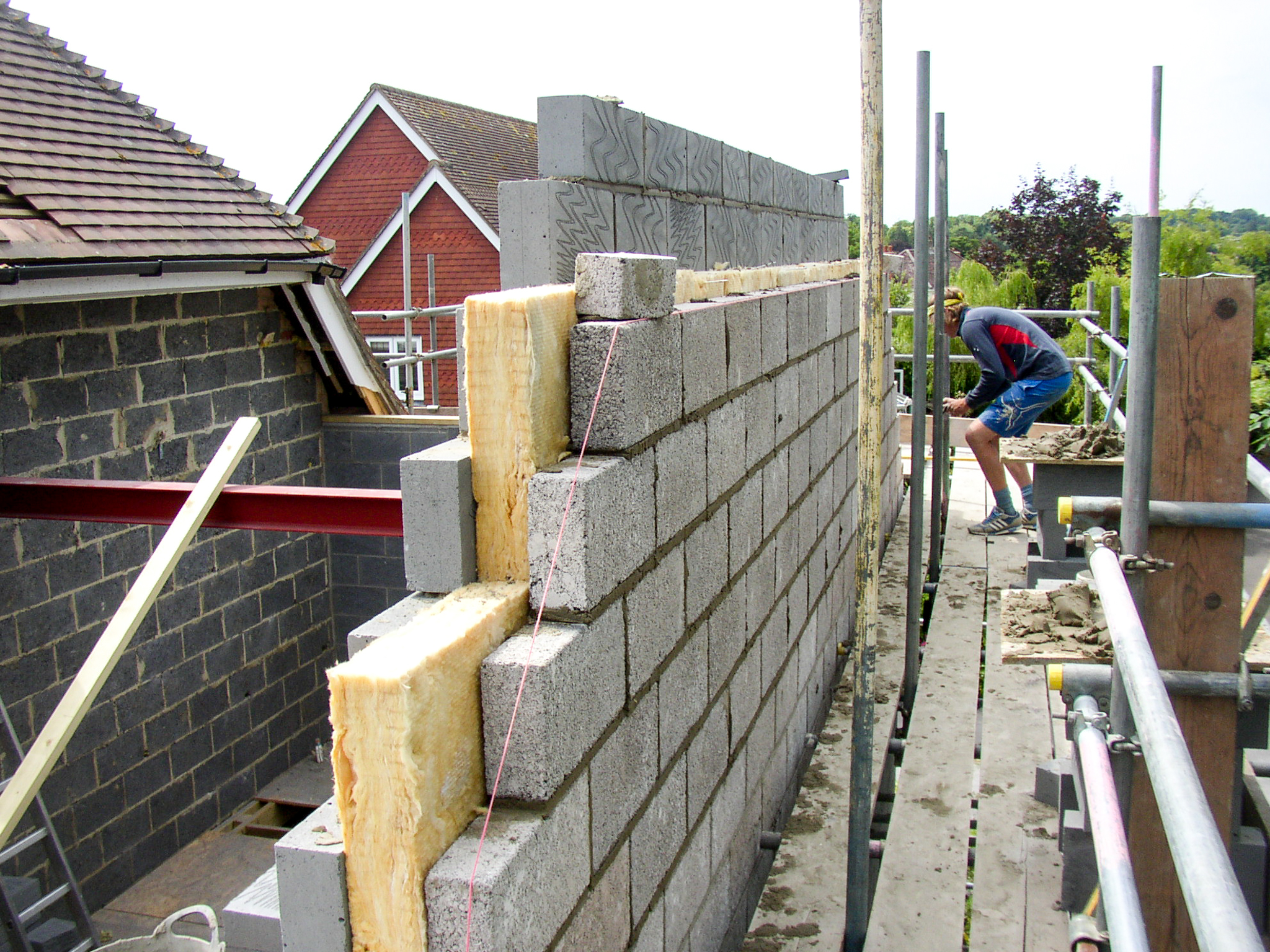
Mainstream insulation materials
First, the conventional options.
Spray foam (polyurethane, polyisocyanurate)
Made from petrochemicals (oil-based plastics), has among the highest carbon footprints of all insulation types. It cannot be recycled, usually ends up in landfill and may release toxic chemicals during manufacture and installation. It also contains blowing agents with high global warming potential. Thermally, however, it performs very well.
Rigid board insulation
For example- PIR (polyisocyanurate), is also derived from fossil fuels with high embodied carbon. There are limited recycling options, creating long-term landfill issues. Despite excellent insulating qualities, it has environmental drawbacks.
Fibreglass insulation
This is made by melting sand and recycled glass at very high temperatures, around 1,600 degrees °C. It is not biodegradable and rarely recycled, usually ending up in landfill.
Mineral wool (rock wool or slag wool)
This is made from plentiful raw materials, but the production process is highly energy intensive. It is not biodegradable, though it is sometimes recycled.
As Martin Evans of Malthouse Sustainability Consultants says: “All materials on a project need to be carefully considered for their environmental impact. New forms of insulation are becoming available that are much more appropriate for a sustainable approach.”
Understanding Insulation Performance:
In ‘An Introduction to Natural Fibre Insulation,’ the Alliance for Sustainable Building Products notes: “When it comes to thermal performance, there is a common misconception that natural fibre insulations underperform, but when we look at broader performance, they often match or exceed manmade alternatives.”
- λ (lambda) value measures how easily heat passes through a material. Lower λ equals better insulation.
- R-value measures how well a specific thickness of insulation resists heat flow. The higher the R-value the better.
Essentially λ tells you the material’s inherent insulating quality, R tells you how effective your installed layer will be.
More sustainable alternatives
Cellulose
Cellulose insulation is made from shredded recycled newspaper and cardboard, processed into a soft fibre. Mineral salts are added in the milling process to make it less vulnerable to rodents and pests and fire retardant. The manufacturing process is relatively low energy. At the end of life, cellulose insulation is fully biodegradable. Cellulose is widely regarded as among the most environmentally friendly insulation materials available. This makes it a great choice for those looking for eco insulation options.
In the UK, key manufacturers include Warmcel and ThermoFloc. In terms of thermal conductivity, cellulose typically has a λ value of around 0.038–0.040 W/mK, broadly similar to mineral wool, giving an R value of approximately 2.5–2.6 per 100mm.
Cellulose can be blown or injected into cavity walls or panels using specialist equipment or used as loose fill in lofts to achieve the desired insulation thickness and spread to form a level surface.
A 12 kg bag of Thermofloc loose fill can be bought from Wormsleys for £28, plus VAT – February 2026 prices. Material consumption is about 4kg/m2 – so it works out at £9/m2. Professional installation bumps up the price. But this need not be a deal breaker if your reason for using eco insulation is doing your bit for the environment.
Sheep’s wool
Sheep’s wool is natural, renewable and breathable with very low embodied energy. The crimped fibres create millions of tiny air pockets that trap heat, enabling sheep to survive freezing temperatures. The wool is washed and treated (often with borax or ionic protection) to protect it from insect or vermin attack. Wool is naturally resistant to fire; it will only smoulder or char rather than burn. Some manufacturers add recycled polyester fibre to improve the rigidity and stability of wool while others keep to 100 per cent wool.
Sheep’s wool is vapour permeable and hygroscopic, meaning it can absorb and release moisture. This reduces the risk of condensation build-up and mould or dampness, making it ideal for timber-frame and older properties. It is also biodegradable and among the best performing natural insulations in terms of λ values (0.035–0.040). A standard 100 mm layer has an R-value of 2.5–2.9, close to rock wool. Brands include Thermafleece, SheepWool and RosEcoMat.
Prices vary according to density and brand with rolls commonly priced from £37 to over £120 per 20kg pack. The main downside is cost. If your goal is reducing carbon footprint, then it’s a great option.
Wood fibre boards
Wood fibre insulation is made from waste wood chips and sawmill byproducts processed into flexible batts or rigid boards. The result is a breathable, vapour-permeable insulation. Its higher density provides useful thermal mass, helping prevent summer overheating as well as winter heat loss. Wood fibre has a relatively low embodied carbon because it uses forestry byproducts and stores the carbon within the material itself.
According to the Natural Building Store, rigid wood fibre is ideal for reduced thermal bridging. These boards are used on the external face of a wall or roof structure to provide a continuous cover of insulation. They can also be used in internal solid wall insulation in retrofit projects.
Manufacturers and suppliers include Steico, Gutex and Pavatex. Thermal conductivity is broadly comparable to mineral wool, depending on density but slightly lower than PIR. Flexible batts often perform at the lower ends while denser boards offer better thermal performance.
Hempcrete and hemp boards
Hempcrete is made from the woody core of the hemp plant mixed with a lime-based binder. It can be cast on site or sold as precast blocks. Hemp absorbs carbon as it grows and the lime binder continues to carbonate over time, meaning hempcrete has a potentially net negative carbon footprint.
This eco-friendly insulation is breathable, regulates moisture and is resistant to moulds and pests, making it particularly suited to retrofit of solid wall properties.
Thermal conductivity typically ranges from 0.04-0.09 W/mK, giving an R Value about 1.2 to 1.7 for typical boards. Because this is lower than most other insulation materials, thicker layers are required. Hemp insulation is not yet widely available, but specialist providers include Ecomerchant, Hemspan and Natural Building Store.
Hemp insulation boards are slightly more expensive than other insulation materials. Ecomerchant offers a (370mm x 1200mm) Indotherm board for £30.51, excluding VAT.
Cork insulation
Cork is harvested from the bark of the cork oak tree without felling it. A fast-growing, naturally occurring material, it is fully renewable, biodegradable and recyclable.
It performs well in damp conditions and is naturally resistant to rot, mould and pests. Thermal conductivity is typically 0.037–0.040 W/mK, giving an R value of around 2.5–2.7 per 100m, comparable to cellulose and mineral wool. Cork insulation is suitable for floors, roofs and external wall insulation systems. UK suppliers include Mike Wye and The Green Building Store.
Cork has very low whole life carbon impact. However, there are concerns about the over-harvesting of cork, reducing the number of cork trees in the world, according to Tim Pullen, an expert in sustainable building materials. He suggests cork doesn’t perform any better than wood fibre, which may have better eco credentials due to it being recycled.
Straw bale
Straw is one of the oldest and lowest-carbon building materials available. Used in bale form, it can act as both insulation and structural infill within timber frames.
Straw bale offers excellent thermal performance due to the trapped air between tightly packed fibres. Thermal conductivity is typically 0.045-0.06 W/MK, giving an R-value of 1.7-2.2 per 100mm which is comparable to fibreglass or wool.
Straw stores carbon during plant growth and is renewable and compostable. The challenge is keeping it free of moisture to prevent rot and deterioration, so the walls require careful detailing. Traditionally a low-cost material, it can be obtained from specialist providers, including The Straw Works and Straw Bale Building UK.
So, is there a greener way?
When affordability and maximum thermal efficiency with minimal thickness are the top priorities, synthetic insulation materials still dominate. If reducing embodied carbon and creating breathable, healthy buildings matter more, natural insulation materials offer a real alternative.