
Greener natural building blocks – “Strocks”
Building with the earth below your feet
When digging foundations for a new home, why send excavated soil to landfill – and pay to do so. Instead, you can turn the waste clay into natural building blocks, literally using the soil beneath your feet to build a house. This eco-friendly method minimises waste and offers a sustainable building solution. In a high-profile example, London’s Tribeca life sciences building used these low carbon earth bricks for its basement walls.
The birth of “Strocks”
The eco-friendly, natural building blocks are the brainchild of Jim Matthews of HG Matthews, a Buckinghamshire-based handmade brick manufacturer. Named “Strocks,” the blocks are crafted from clay-rich earth and chopped straw, offering a greener alternative to traditional concrete blocks. Inspired by ancient building techniques dating back to the mud bricks of Mesopotamia, Strocks are made from clay mixed with wheat straw for binding.
 Image supplied by HG Matthews
Unlike conventional bricks, Strocks don’t require firing at over 1,000°C. Clay is found in many parts of the UK, yet only specific clays can withstand the stress of very high temperature firing. By eliminating the need for firing, a wider range of clay-rich soils can be used, transforming an overlooked yet plentiful resource into a valuable building material.
HG Matthews evaluates excavated soil to determine its suitability for Strock production, including strength testing. Logan Philips, of HG Matthews, explains: “We are happy to test soil from footings to see if it’s suitable for making natural blocks. The more soil we can test across the UK, the better.” Clay rich soils work best. “Chalky soil is a pain,” he admits, “but we are still happy to test because these blocks don’t require firing.”
Why It Matters: A Greener Future in Construction?
In the UK, the construction industry uses around 250 million tonnes of sand, gravel and crushed rock each year, outstripping the approval of new quarries. Meanwhile, cement production contributes about eight per cent of global carbon dioxide (CO2) emissions. The building industry urgently needs to find greener solutions. HG Matthews is leading the way by championing low carbon production techniques and sustainability in material resources.
Will Stanwix, Strocks technical development manager, explains: “Strocks are made from waste clay we dig through to get to our brick making clay and waste straw from local farms. The raw materials are sourced within half a mile of where the blocks are produced.” Instead of high energy kilns, biomass boilers fuelled by locally sourced wood chips dry the blocks, resulting in lower emissions. Recycled rainwater is also incorporated in the mix, further reducing the environmental impact.
The blocks remain eco-friendly at the end of their life cycle. Stanwix explains: “Strocks are a natural material from the earth. Not only are they high performing but unlike so many other so-called green building materials, provide absolutely zero toxicity to the environment at the end of a building’s life.”
Healthier, More Comfortable Living Spaces
Strocks don’t just have impressive green credentials, they create healthier living spaces than concrete blocks. As Stanwix explains on the company website: “Strocks are made from an unfired clay which is vapour permeable or a breathable material. This means they can regulate internal humidity. When your house is very humid, they will take in moisture. When the air is drier, they will give out moisture.” This maintains a comfortable 40-60 ° humidity. This not only has positive health benefits, but it also reduces the need for complex ventilation systems. The natural regulation makes simpler, more energy efficient trickle vents or passive ventilation systems more viable options.
Built for Strength, Safety and Simplicity
Strocks are load bearing blocks, used for the primary structure of the building. They achieve a strength rating of 1.5Nm/mm2, enough to support most domestic loads in one or two storey houses. To showcase their strength, HG Matthew’s website features a video of a dumper truck driving over Strocks - remarkably, they neither crack nor crumble. Strocks have been fire-tested at over 1,000° Celsius and proven to be fireproof. “There is no risk of combustion. There is no risk of spread of flame,” says Stanwix. Additionally, Strocks are easy to work with: they can be cut with a multitool and screws can be inserted directly without the need for wall plugs, much like timber.
Versatile Applications
Strocks are suitable for various uses, including new build homes, repairing traditional earthen buildings and to provide a structural base to earth floors, say HG Matthews. The natural building blocks can be used as the inner leaf of a cavity walls, replacing concrete blocks or solid walls with sustainable insulation. On the inside, they can be covered with lime plaster or a clay plaster and then painted with a breathable paint for a greener build. Many people, however, prefer the natural sandy finish of Strocks, leaving them unpainted, says Philips.
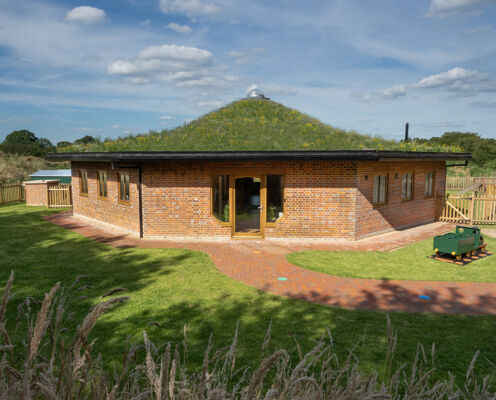
Image supplied by HG Matthews
While they offer numerous benefits – low embodied carbon, 100% natural materials, ease of use and energy efficiency - a Strock block is currently about £1 more expensive than a traditional concrete block. HG Matthews is working to reduce costs as production scales up. “Our end goal is making building more sustainable for everyone,” says Philips. HG Matthews is showing that a greener, low-carbon future is not only possible, it’s here already.
For more information see www.hgmatthews.com